Short answer
What has Google announced?
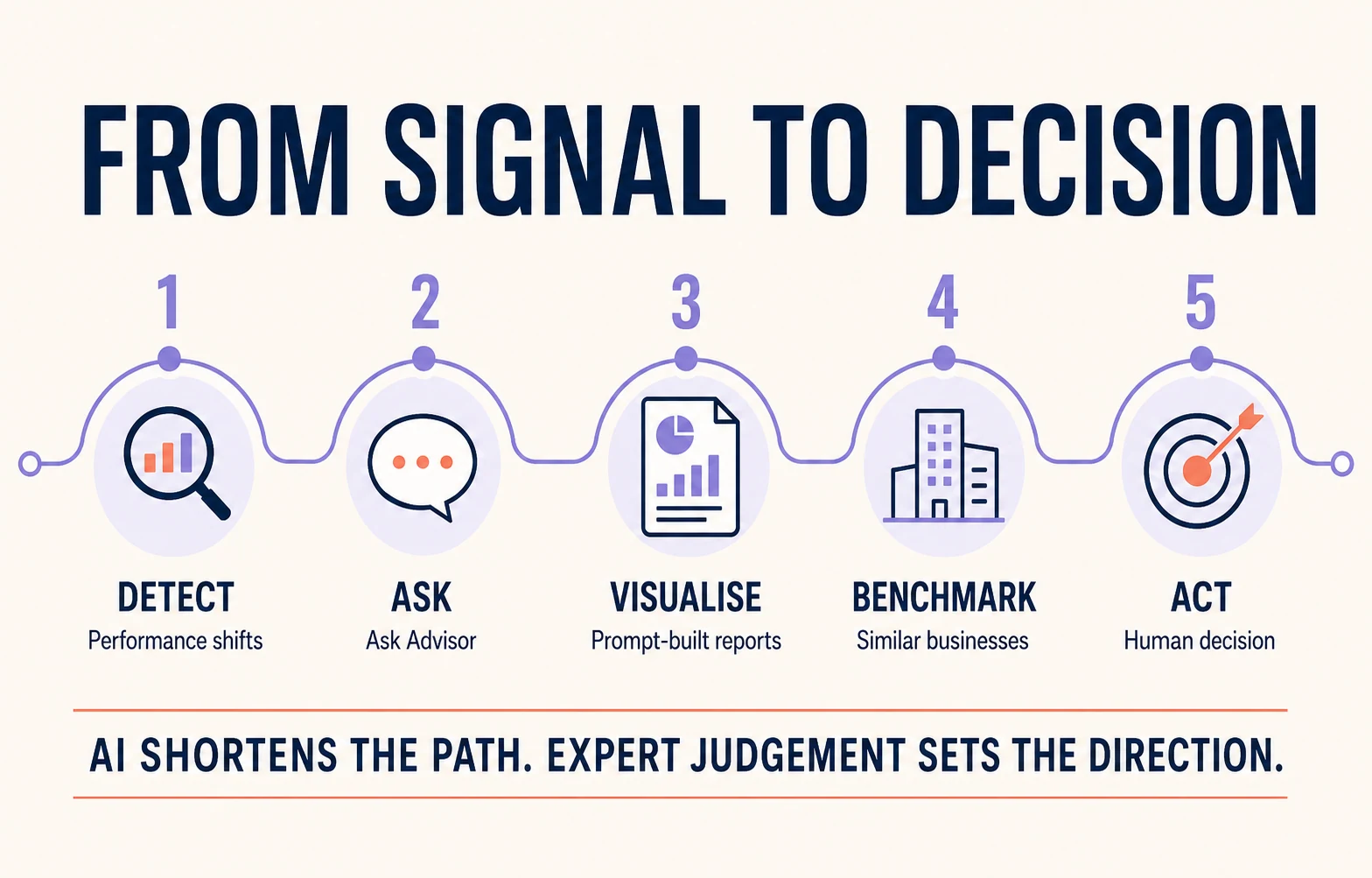
Google is bringing new AI and agentic features to Google Ads and Google Analytics. They include AI Overviews on the Analytics homepage, personalised insight cards in Google Ads, dashboards created from text prompts and anonymised benchmarks through Ask Advisor. The tools are designed to explain changes faster and simplify analysis. They do not replace accurate tracking or expert review of a recommendation.
The four updates
From the homepage to a useful benchmark
AI Overviews in Analytics
The Analytics homepage summarises important developments since your last visit, such as seasonal sales peaks or traffic changes.
Personalised Google Ads insights
New cards surface timely insights tailored to your business. A prompt box lets you investigate a question that matters to you.
Dashboards from text prompts
In Google Ads, simple text prompts can turn raw data into visual reports. An automatically generated real-time summary explains possible reasons behind the data. The capability is also planned for Analytics.
Anonymised benchmarks
Ask Advisor in Analytics can compare campaign performance with anonymised averages from similar businesses, helping reveal possible room for improvement.

Our view
Faster analysis is useful. Automated certainty would be dangerous.
Meltzer Media welcomes tools that surface important changes faster and reduce routine reporting work. In larger accounts especially, a good summary can help teams ask the right question sooner.
An AI-generated insight is a hypothesis, not a completed analysis. Seasonality, tracking changes, campaign restructuring, conversion delays or a changed offer can produce similar movements. Every important recommendation should therefore be checked against the underlying data and the commercial context.
The right role
What these tools should do for you
Detect earlier
Use summaries as an early-warning system for unusual movements, not as a final verdict.
Ask better questions
Ask narrow questions about a period, campaign, conversion goal and metric. General prompts tend to produce general answers.
Form hypotheses
Use the tools to surface possible causes, then decide which explanation can be checked with a report or controlled test.
Document decisions
Record which insight led to which check and action. That is the only way to judge later whether the recommendation was useful.
In practice
A sensible review process
The new tools become valuable when they are paired with reliable data and clear ownership.
- 1
Check the measurement foundation
Review conversion actions, values, consent settings and the connection between Google Ads and Analytics.
- 2
Validate against source data
Open the relevant date range and segment by campaign, device, location or conversion goal.
- 3
Add business context
Account for promotions, price changes, stock, website problems and measurement changes.
- 4
Test one controlled decision
Make one clearly limited change, define success criteria and avoid several simultaneous interventions.
- 5
Record the outcome
Document the hypothesis, change, period and outcome. That is how faster analysis becomes better management.
FAQ
Common questions about the new AI features
Are these features available in every account?
No. Google currently describes the announced capabilities as a beta for English-language accounts. Rollout can vary by product and account.
Does Ask Advisor replace an analyst or Google Ads specialist?
No. The tool can summarise data, investigate questions and suggest possible next steps. Measurement quality, commercial interpretation and responsibility for changes remain human tasks.
How useful are anonymised benchmarks?
They provide direction, not an individual target. Similar businesses can have different margins, markets, conversion definitions and growth stages. Treat benchmarks as context rather than a standalone control metric.
Recommended reading
Read Google’s original article as well
We explicitly recommend Google’s original article. Its short product demonstrations cover AI Overviews, the new report canvas and benchmarking, showing more clearly than a summary how Google expects the tools to fit into the workflow.
Source
Official Google announcement
This article was reviewed on 15 August 2026 against Google’s official announcement. Beta features and availability can change.
Google: Evolve your marketing with new AI tools