Our position
Meltzer Media supports greater AI transparency in advertising
Google’s new disclosures are a sensible step. People should be able to understand when generative AI created or altered an ad. That does not make AI automatically good or bad. It gives viewers better context. Advertisers still need to ensure that claims are accurate, rights are cleared and every ad is reviewed before it goes live.
The announcement
What Google is changing
Google is expanding the information available for ads created or edited with generative AI. The main changes concern visibility, automatic disclosure and a new way for advertisers to declare the use of external AI tools.
A new information panel
A ‘How this ad was made’ section will indicate whether AI was used to create or edit an ad.
Across key Google surfaces
The section is accessible from the three-dot menu or information icon on ads across Search, YouTube and Discover.
Automatic for Google AI
When Google’s own generative advertising tools are used, Google will add the disclosure automatically.
Disclosure for external tools
For ads made with other AI tools, Google is introducing an advertiser control. Depending on local requirements, a label may also appear directly on the ad.
Responsibility
What an AI label does not do for you
A disclosure describes how an asset was made. It does not confirm that the ad is accurate, compliant or effective. That responsibility remains with the person or business publishing the campaign.
Check the facts
Product details, prices, deadlines and performance claims must be accurate.
Clear the rights
Brands, images, voices, people and other protected material need a proper basis for use.
Protect the brand
The ad needs to match the offer and the customer experience it represents.
Measure the outcome
More variations help only when conversion data shows which message genuinely works.
In practice
A sensible workflow for AI-assisted ads
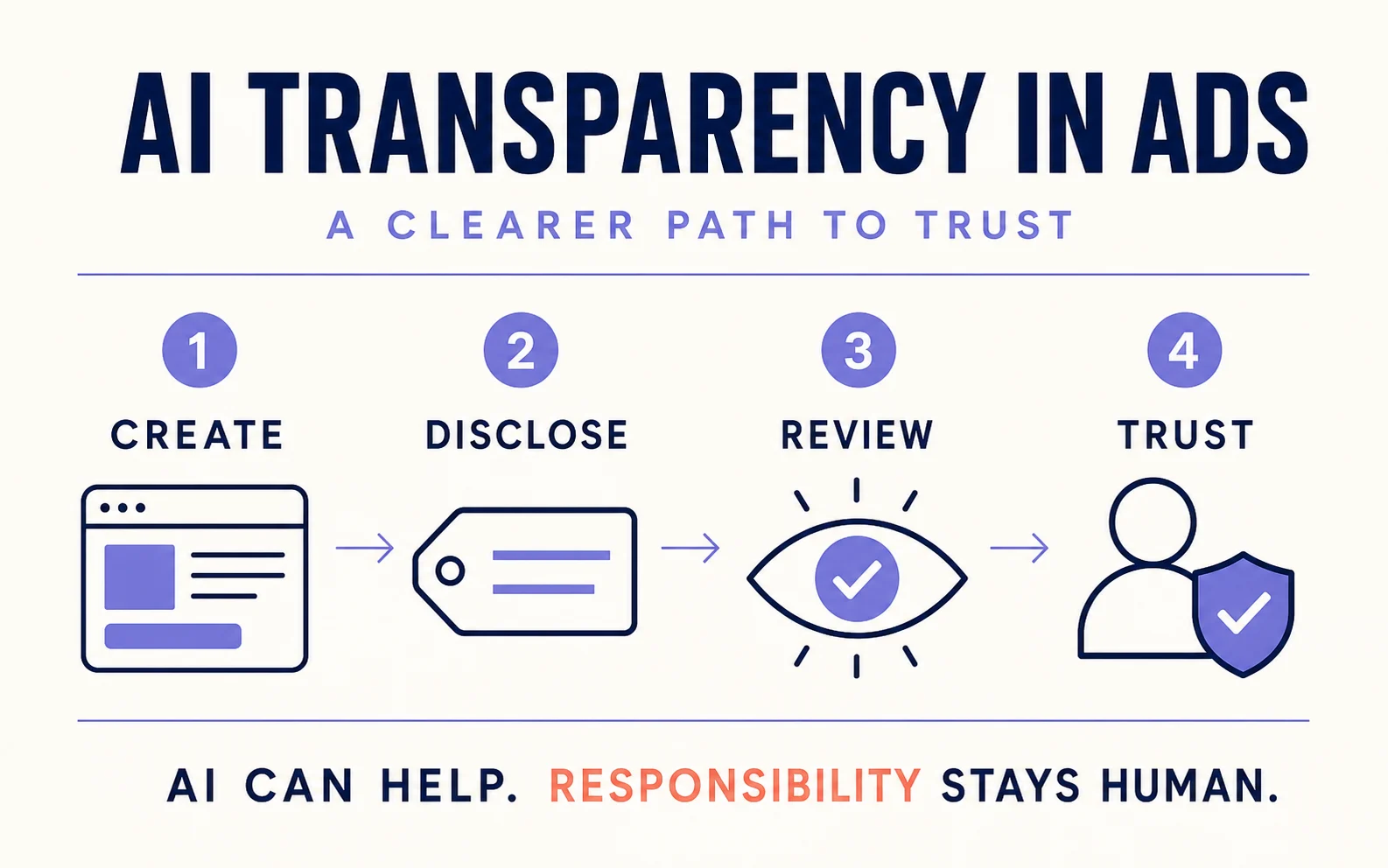
Using AI in ad production does not require a complicated separate process. Four clear checkpoints provide a solid foundation.
- 1
Document the use
Record which tool was used and which parts of the asset it affected.
- 2
Check the claim against the source
Compare the copy and visual against product data, the offer and approvals.
- 3
Approve it as a human
A responsible person checks context, tone, accuracy and possible misinterpretation.
- 4
Disclose correctly and measure
Use the available disclosure controls, then judge the ad by real business outcomes.
The bigger point
Good advertising is not defined by the tool
A human-made ad can be misleading. An AI-assisted ad can be accurate, useful and on-brand. What matters is the quality of the inputs, the honesty of the message and the review before publication. Google’s existing policies against misleading advertising continue to apply regardless of how an ad was made.
That is why we welcome the new transparency. It allows innovation without withholding useful context from the audience. Digital advertising needs exactly that balance between automation and responsibility.
Official sources
Read more from Google
This article was reviewed on 10 August 2026 against Google’s official announcement. Features and requirements can change.