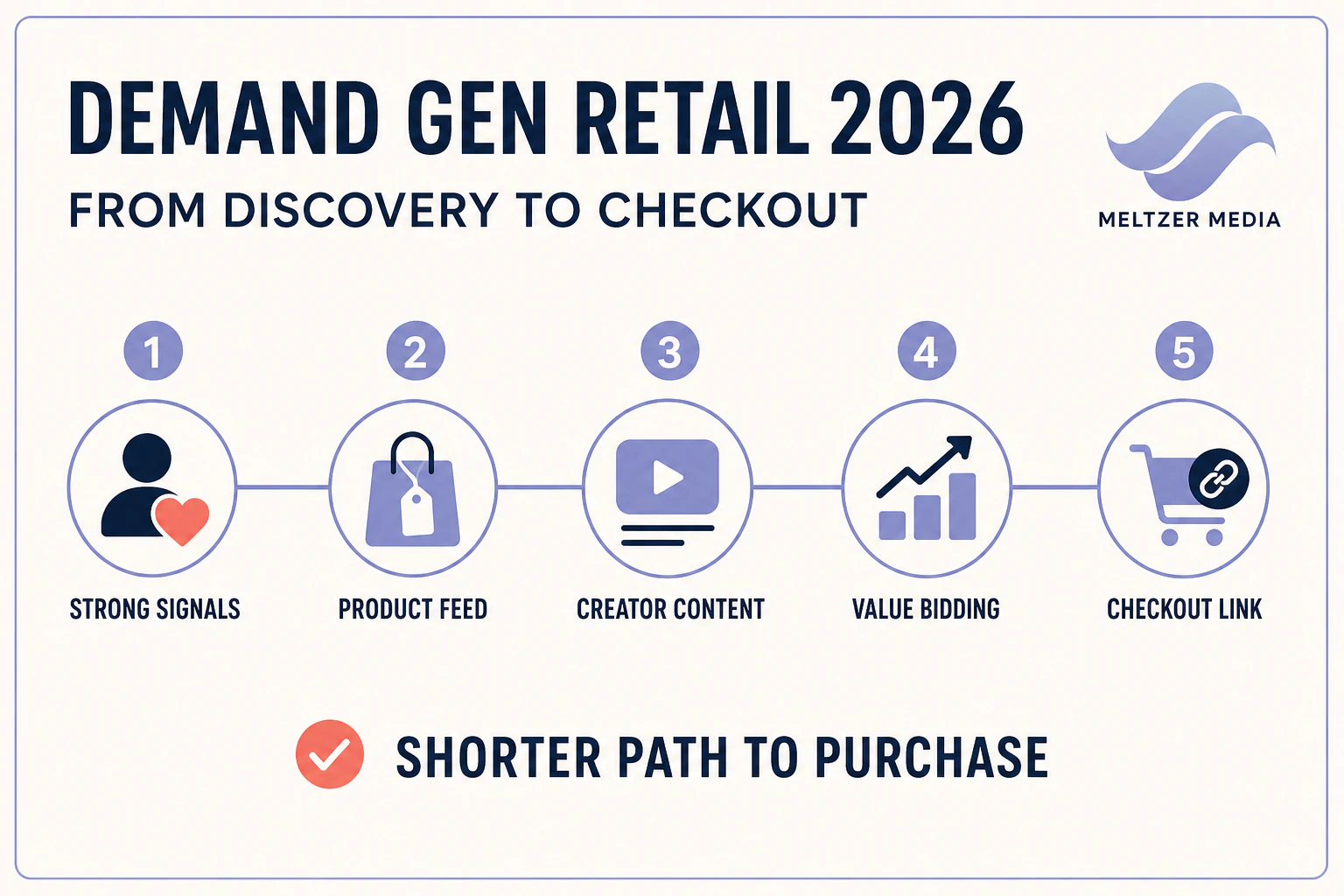
On 29 July 2026, Google published the eleventh edition of its Demand Gen Drops. The focus is holiday retail and one clear question: how can video inspiration turn into a purchase with fewer steps in between?
What Google actually announced
Google is connecting Demand Gen more closely to the full ecommerce journey. Product data, creator content, value-based bidding and direct checkout routes are being positioned as one system.
According to the original Google article, 94 percent of surveyed holiday shoppers who used YouTube reported taking another step towards a purchase after watching a related video. The underlying Ipsos survey covered US consumers.
Checkout Links shorten the path
Checkout Links can send someone from a Demand Gen ad directly to a cart or checkout page on the merchant’s website. Google added Switzerland, Australia, South Korea, Indonesia, Mexico, France, Poland, Israel and Argentina.
Google reports an average six percent conversion lift for Demand Gen advertisers that supplied Checkout URLs. The cited analysis uses US data from September 2025. That is promising, not a guarantee. Results still depend on checkout speed, trust, mobile usability and traffic quality.
Before using the feature, check Google’s current Checkout Links requirements. Product, price, availability and landing page need to agree.
tROAS gets bolder, but still needs reliable values
The updated Target ROAS logic is designed to be less cautious early on and help campaigns reach their targets faster. That may improve the learning phase. It does not make weak conversion values more useful.
Before switching, revenue values, conversion delay and the profitable target range should be reliable. Google’s current Target ROAS guidance remains the technical baseline.
Product feeds and creator content need to sell
Google recommends connecting product feeds to visual Demand Gen ads and scaling authentic creator content through Affiliate Partnerships Boost. UCP is intended to enable purchases from YouTube ads, but in this context it is initially available only in the US.
A feed is not an admin document. Product titles, images, prices and landing pages are part of the sales message. Creator content also works only when the benefit, proof and offer become clear within seconds.
What we would test now
- Check measurement: Revenue values, consent, Enhanced Conversions and conversion delay need to be accurate.
- Prioritise the feed: Start with products that combine margin, stock and demand.
- Sharpen the message: Make the problem, benefit and proof clear before scaling new formats.
- Shorten the purchase path: Test Checkout Links only with a fast, trustworthy mobile experience.
- Judge commercial value: Compare revenue, contribution margin and new-customer value, not just reported conversions.
Our view
Demand Gen is moving from a visual reach format towards a more integrated retail channel. The opportunity is not one new setting. It comes from connecting strong signals, relevant products, persuasive creative and as little post-click friction as possible.
If the ecommerce campaign structure needs to be decided first, read our Standard Shopping versus Performance Max comparison.